




"Effective Fervent Prayer"
James 5:12-18
| Lesson | Author | Date | File |
|---|---|---|---|
"Effective Fervent Prayer" |
Wallace, Steven | 2026.07.12 | |
| Revelation And Creation PowerPoint and Audio Material | |||
Sermon Summary
Central Truth
“The effective, fervent prayer of a righteous man avails much” (James 5:16).
Effective prayer is not a ritual formula, emotional display, or religious technique. It is the earnest appeal of a righteous person who approaches the living God through Jesus Christ, submits to God’s will, walks faithfully before Him, and trusts Him enough to keep praying.
Hebrews 4:14–16 gives us confidence to pray because:
-
We have a great High Priest.
-
He has passed through the heavens, His work completed and approved.
-
He is Jesus, the divine Son of God.
-
He sympathizes with our weaknesses.
The question is not whether God is able to hear or whether Christ is sufficient to help. The question is whether we are praying as God teaches.
1. Effective Prayer Is Directed to God
Matthew 6:9
Jesus taught His disciples to pray:
“Our Father in heaven, hallowed be Your name.”
Prayer is not meditation into the air, religious self-talk, emotional venting, public performance, or vain repetition. It is addressed communication with God.
“Our Father” speaks of nearness.
“In heaven” guards reverence.
We come as children who trust their Father, not as consumers placing an order. Prayer is not opening a menu and telling God what He must provide.
The man who refuses manipulative speech before men must also refuse manipulative speech before God. There must be no showmanship, empty formulas, or attempts to force heaven open—only honest appeal to our Father in heaven.
Key truth: Prayer is not performed before men; it is reverently poured out before God.
2. Effective Prayer Is Shaped by God’s Will
Matthew 6:10
“Your will be done.”
Prayer is not an attempt to bend God to my will. It is the yielding of my will to God.
Submission comes before supplication.
People often measure prayer by whether they received what they wanted. Scripture measures prayer by whether they sought what God wanted.
Jesus modeled this in Gethsemane:
“Nevertheless, not as I will, but as You will”
(Matthew 26:39).
If the sinless Son of God submitted His request to the Father’s will, how much more should we?
Confidence in prayer does not come from demanding our way. It comes from asking according to His will and trusting His wisdom.
The prayer of faith is not faith demanding its own way; it is faith trusting God’s way.
Sometimes effective prayer changes the circumstances. Sometimes it first changes the person who is praying.
Key truth: Prayer does not enthrone my will; it bows before His.
3. Effective Prayer Requires a Life Aligned with God
Matthew 6:11–13; James 5:16
James places the words “a righteous man” between “effective, fervent prayer” and “avails much.”
This does not mean a sinless person. Elijah was “a man with a nature like ours” (James 5:17). Effective prayer does not belong only to flawless people, but to those who are walking honestly with God.
Prayer is not a substitute for obedience. Sin places a roadblock in the path of prayer.
“If I regard iniquity in my heart,
the Lord will not hear”
(Psalm 66:18).
When a person refuses to listen to God, he cannot presume that God will listen favorably to him.
This principle reaches into our treatment of others. Peter warned husbands to honor their wives so that their prayers would not be hindered (1 Peter 3:7). God does not separate a man’s prayers from the way he treats his wife.
A husband must not become:
-
A tyrant—harsh, sharp, and dismissive.
-
A turtle—passive, withdrawn, and unavailable.
He should be a shepherd in the home: present enough to understand, humble enough to honor, strong enough to lead, and tender enough to care.
Prayer does not cover unrepented sin. It is not a substitute for repentance, but it is often the voice of repentance.
Matthew 6:11–13 portrays the life of one who prays effectively:
-
Dependent: “Give us this day our daily bread.”
-
Penitent: “Forgive us our debts.”
-
Forgiving: “As we forgive our debtors.”
-
Watchful: “Do not lead us into temptation.”
-
Reliant: “Deliver us from the evil one.”
The same disciple who asks God for bread must also ask God for rescue.
Key truth: The prayer that reaches toward heaven must rise from a life that is walking toward God.
4. Effective Prayer Is Offered with Fervent Faith
James 5:16–18
James says that Elijah “prayed earnestly.” The expression carries the idea that he “prayed with prayer.” He did not merely say a prayer—he truly prayed.
There is a difference between saying prayers and praying.
Elijah’s prayer was not a cold ritual or empty religious habit. It was the earnest appeal of a man who believed that God hears and acts.
Elijah did not control the weather. He trusted the God who rules heaven and earth.
Effective prayer also persists. Elijah sent his servant seven times to look toward the sea before the small cloud appeared. Jesus likewise taught that men “always ought to pray and not lose heart” (Luke 18:1).
Persistence does not mean forcing God’s hand. It means trusting God’s heart while waiting upon His will.
Effective prayer avails much, but not always in the way we expect.
-
Sometimes God changes the circumstances.
-
Sometimes God changes us within the circumstances.
-
Sometimes He provides deliverance.
-
Sometimes He provides grace sufficient to endure.
Prayer does not make us sovereign. Prayer confesses that God is sovereign.
Key truth: Fervent prayer keeps trusting when the answer has not yet appeared on the horizon.
Conclusion
Effective prayer is not magic, manipulation, performance, or religious noise.
It is:
-
Directed to God.
-
Shaped by God’s will.
-
Joined to a righteous life.
-
Offered with fervent faith.
The same God who heard Elijah still hears His faithful people today.
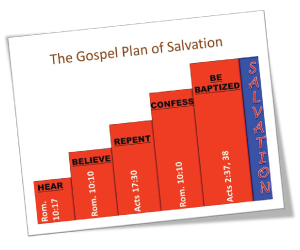
For the alien sinner, the good confession is not a recital of everything he has done, but a confession of who Jesus is. He must believe in Christ, repent of sin, confess Christ, and make the obedient appeal of faith in baptism for a good conscience toward God.
Come to God through Christ, on His terms, while mercy remains open.
Sermon in One Sentence
Effective prayer is the earnest appeal of a righteous person who approaches the Father through Christ, yields to God’s will, walks obediently before Him, and keeps trusting even when no cloud has yet appeared.

"From Eden to Eternity"
Two builders build houses. Two lives are lived. One falls in the storm while the other one stands. What is the difference?

"The Syro-Phoenician Woman"
An old exhortation needs to be fresh in our daily activities--continue in the faith!

Come Visit!
"Appointed for the defense of the gospel"
MT. BAKER CHURCH OF CHRIST
1860 Mt. Baker Hwy.
Bellingham, WA 98226